The Half-Empty Noticeboard: Auditing Who Your Campaign Never Reaches
A campaign I know had four thousand followers and twelve people at its public meeting. The campaign was not bad. The problem was simpler: the people most affected by the issue did not live on Instagram. They were on the bus, in the launderette, outside the school gate, and in the post office queue. Nobody had asked whether they could find us.
That is the noticeboard test. Not a nostalgic shuffle back to paper, and not a rejection of digital tools. It is a check on whether your campaign exists for people who are not already in your feed. Digital inclusion is not only about getting people online. It is about refusing to abandon the people who are not.
Start with a map, not a mailing list
Before you print anything, walk the area you claim to organise in. Not a quick drive. A slow walk, ideally at different times of day. Where do people wait, queue, sit, shelter or chat? The library. The post office. The pharmacy. The launderette. The chip shop. The pub. The corner shop. The leisure centre. The food bank. The warm hub. The school gate at 3pm. The mosque, church, temple or gurdwara. The allotment shed. The barber's window.
Mark them on a map. Note opening hours, footfall times and who owns the space. A digital-first campaign can still be a good campaign. A digital-only campaign is a smaller campaign than it thinks it is.
Permission is the outreach
Do not blu-tack over someone's bereavement notice. Ask first. Ask a named person, not a vague 'someone in the office'. Ask what they will allow: A4 or A5? Inside the window or on the outside board? For one week or two? Do they want you to remove it yourself? Keep a simple permission log — date, place, contact name, what was agreed, when you will take it down. This is not admin for its own sake. It is how you build a relationship that will still be there after the poster has gone.
The poster has to survive a British November
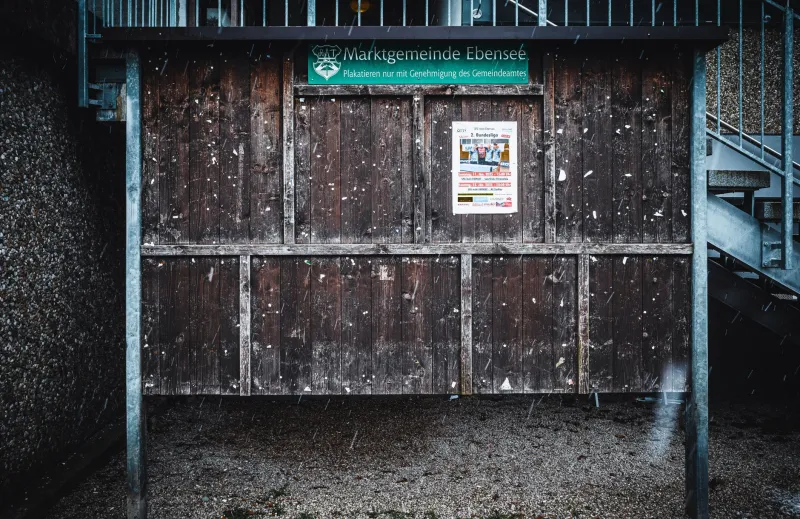
A4 paper and four bits of Sellotape is not outreach; it is litter with a message. Laminate, or use waterproof sleeves. Use cable ties rather than tape where you can. Eyelets are worth the extra cost if the board is exposed. Design for the weather and for tired eyes: large sans-serif type, high contrast, key information in the top third. Who, what, where, when, and how to get involved. A real phone number. Accessibility information. Plain English.
QR codes are fine as an extra route. They must never be the only route. If someone has no smartphone, a dead battery or no data, the poster still has to work. A tear-off tab with the phone number and meeting time is old technology that still beats a broken link. A5 works well in shop windows; A4 for community boards. Avoid dark backgrounds if you are printing cheaply, because they turn into a grey smear by Tuesday.
Recruit noticeboard allies
Library staff, shopkeepers, faith leaders, care workers, barbers, pharmacists and receptionists already talk to more local people in a week than your best social post will reach in a month. Ask them to mention the campaign. Give them a small stack of posters and a one-line script. Offer to refresh the poster yourself. Thank them properly. The best distribution network is not a leaflet company. It is a person who knows fifty people by name.
Track offline without turning into a surveillance project
You do not need to count every eyeball. You need to know whether offline outreach is shifting who turns up. Use a different code per location — 'mention LAMPPOST when you call' — or a simple tally sheet at the door asking how people heard about the meeting. Ask at the start of the meeting, not the end. Keep a weekly count by location. Notice when 'word of mouth' really means a poster plus a neighbour. Offline reach is fuzzy; measure direction, not precision.
The test is not nostalgia
The noticeboard test is simple: can someone with no smartphone, no email and no social media find out what you are doing, when it is happening, and how to join? If the answer is no, your campaign is smaller than you think. Fix that before you book the next Facebook ad. The point is not to abandon digital organising. It is to stop pretending that a post is a plan.